
Finding the right gaming console for your family isn’t just about graphics or processing power, it’s about creating shared experiences that work for everyone from toddlers to teenagers. Whether you’re looking for the best gaming console to buy for family game nights or something the kids can enjoy independently, 2026 has delivered more options than ever before. The gaming landscape has shifted dramatically over the past few years. Consoles are no longer isolated devices: they’re gateways to entire ecosystems of entertainment, education, and social connection. Parents want safety features that work. Gamers want performance and library depth. Younger kids need age-appropriate content and intuitive controls. The good news? There’s genuinely something here for everyone. This guide breaks down the best family gaming consoles of 2026, comparing everything from the Nintendo Switch’s unmatched portability to the PlayStation 5’s raw power, plus budget-friendly options that won’t drain your wallet. We’ll walk through what each platform offers, how to keep gaming safe, and how to make the right choice for your household’s specific needs.
Key Takeaways
- The Nintendo Switch remains the top family gaming console for its unmatched portability, intuitive controls, and multi-generational appeal with titles like Mario Kart and The Legend of Zelda that work for all ages.
- PlayStation 5 and Xbox Series X|S offer different value propositions: PS5 prioritizes cutting-edge graphics and third-party variety, while Xbox Series S delivers the best budget option at $299 with Game Pass providing hundreds of games for $16.99/month.
- All modern consoles include robust parental controls, ESRB rating filters, and screen time limits—parents should research specific safety features and match game ratings to their child’s maturity level rather than just age.
- Family gaming consoles create shared experiences where multiple age groups engage simultaneously, unlike passive entertainment; properly managed gaming develops problem-solving skills, coordination, and social bonding.
- Budget-conscious families can start with the Nintendo Switch Lite ($199), Xbox Series S ($299), or refurbished previous-generation consoles, which have identical game libraries to newer models and perform perfectly for casual family gaming.
Why Choose a Family Gaming Console?
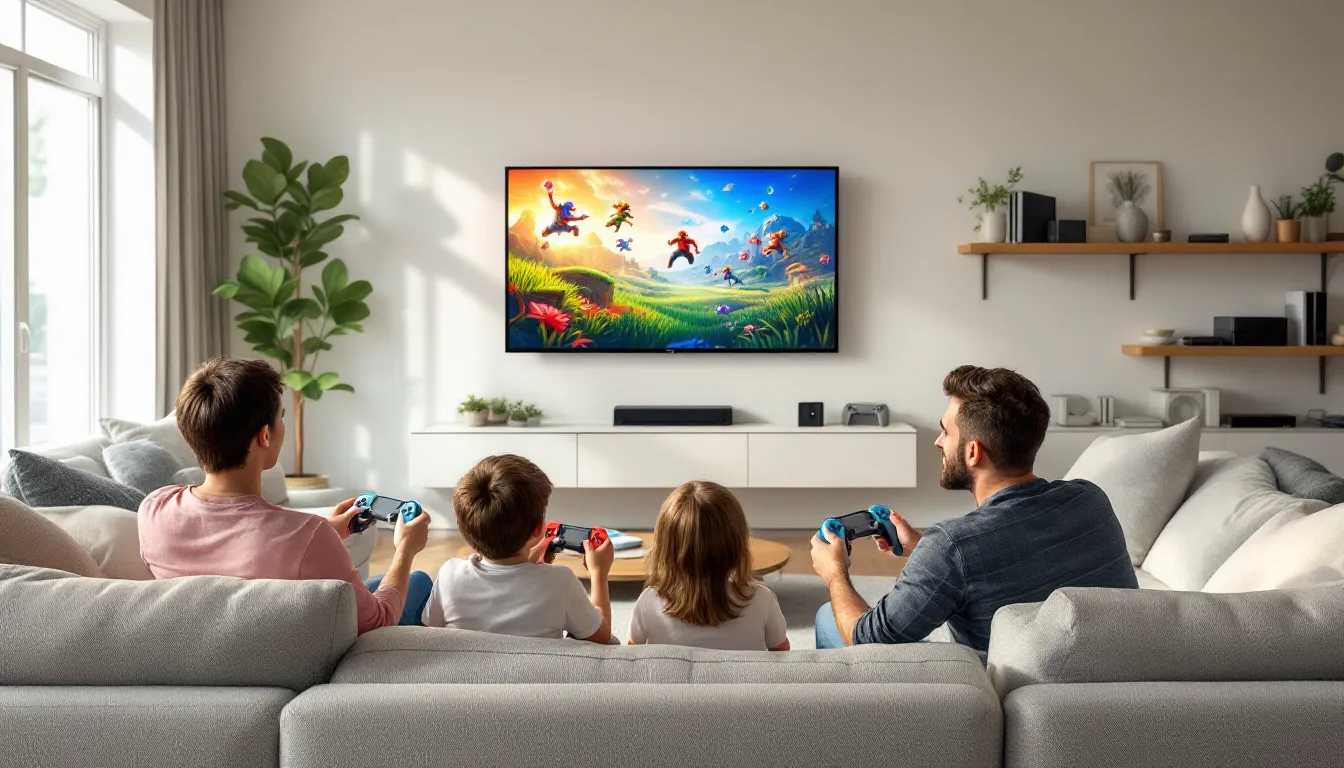
Gaming consoles have become essential household entertainment devices, not just for gamers, but for families building memories together. Unlike isolated gaming on phones or tablets, a console with multiple controllers transforms living rooms into interactive entertainment hubs where everyone participates.
The appeal is practical. A family gaming console means shared screen time with built-in parental controls, varied game libraries that span from toddler-friendly titles to competitive multiplayer experiences, and physical controllers that encourage couch co-op play. Kids develop problem-solving skills through puzzle games, coordination through platformers, and teamwork through multiplayer adventures. Parents get peace of mind knowing what their kids are playing and how long they’re playing it.
More importantly, consoles create focal points for family connection. Game nights become rituals, something every generation in the household can enjoy simultaneously. Unlike streaming, where everyone’s watching the same passive content, gaming lets each family member engage at their own skill level. A 4-year-old can enjoy the colorful chaos of Mario Kart while their 14-year-old sibling pursues competitive times. Parents can jump in or watch and coach. That’s the real value proposition of family gaming consoles in 2026.
Nintendo Switch: The Gold Standard for Family Gaming
If there’s a runaway champion for families, it’s the Nintendo Switch. No console has better understood the assignment of multi-generational play. The hybrid design, portable handheld that docks into a TV, means your kids game on the couch, then carry the entire ecosystem to the car, a friend’s house, or vacation. That flexibility is genuinely unmatched.
The Switch library is staggering in breadth. Mario Kart 8 Deluxe is legitimately the best party game ever released. Super Smash Bros. Ultimate appeals to both casual button-mashers and frame-data nerds analyzing frame advantage. The Legend of Zelda: Breath of the Wild and Tears of the Kingdom are considered among the greatest games ever made, they’re also perfectly playable by kids as young as 6 with minimal guidance. Animal Crossing: New Horizons, Splatoon 3, Nintendo Switch Sports, and countless others mean nearly every interest and age group finds their game.
The Switch’s greatest strength? Accessibility. The controls are intuitive. Joy-Con controllers are small enough for young hands but precise enough for complex inputs. The online experience is straightforward without feeling overwhelming. Games rarely demand reflexes beyond 8-year-olds but offer depth that satisfies teenagers and adults.
OLED Model vs. Standard Switch
The Nintendo Switch lineup now includes three tiers, which can confuse buyers. Here’s the breakdown:
Nintendo Switch OLED ($349): The premium option. The 7-inch OLED screen looks noticeably sharper and more vibrant than LCD panels, especially when handheld. The kickstand is genuinely better for tabletop play. Storage is doubled to 64GB. If your family will play portably more than docked, this is worth the premium. The difference isn’t subtle, games like Splatoon 3 look tangibly better on OLED.
Nintendo Switch Standard ($299): The current sweet spot. The LCD screen is perfectly adequate for most players and older games were designed around it. You lose some visual pop compared to OLED, but save $50. For families buying their first console, this makes financial sense.
Nintendo Switch Lite ($199): Handheld-only, smaller, lighter, and significantly cheaper. Perfect as a second device or for kids who’ll never dock to a TV. The trade-off: no TV connection, smaller screen, and smaller controllers. Not ideal if your family plan is living room gaming, but excellent for portability.
For a family console, the OLED or Standard models make sense. The Lite works as a secondary device or for kids with their own dedicated portable unit.
Best Games for Families on Switch
The library depth on Switch is overwhelming, so here are the essential family titles:
Mario Kart 8 Deluxe: If you buy a Switch, this should be in the box. Zero learning curve, instant fun for all skill levels, and the blue shell chaos creates shared moments every family needs. 150cc feels competitive while 50cc accommodates younger players. Battle modes add hours beyond single-race novelty.
Super Mario Bros. Wonder: The latest 2D Mario released in late 2023. The elephant power-up, gravity flips, and flower mechanics make platforming accessible without feeling simplistic. Single-player works great: co-op is joyful and forgiving.
Mario Party Superstars: Five classic Mario Party titles remade. Turn-based gameplay means everyone gets their moment. No skill advantage, pure chaos, kids find this hilarious, adults find it strategically interesting. Pro tip: play on higher difficulty settings if your adults want actual challenge.
Nintendo Switch Sports: The bundled spiritual successor to Wii Sports. Tennis, bowling, golf, badminton, volleyball, and soccer. Intuitive motion controls, quick matches, genuinely competitive multiplayer. Much better than early Wii Sports sequels.
The Legend of Zelda: Tears of the Kingdom: An 8-year-old can explore Hyrule and feel like a hero. Teenagers will spend 100 hours solving impossible-looking puzzles. Massive, beautiful, and endlessly captivating.
Animal Crossing: New Horizons: Peak relaxation gaming. No timers, no combat, no judgment. Decorate your island, catch creatures, chat with adorable villagers. Kids get creative expression: adults get a meditation tool. Genuinely a family throughline that keeps people returning for months.
Platform games also dominate Switch. The Best PS5 Platform Games showcase how beloved the genre is, and Switch offers its own excellent selection including Donkey Kong Country Tropical Freeze, Kirby’s Dream Land 3, and Sonic Frontiers, titles that bridge casual accessibility and gamer satisfaction.
PlayStation 5: Powerful Gaming for Growing Gamers
The PlayStation 5 represents the opposite philosophy from the Switch, maximum graphical power in a living room console. If your family wants cutting-edge visuals, a massive third-party game library, and the gaming horsepower to run anything released, the PS5 ($499–$749 depending on model) is the answer.
The PS5’s advantage isn’t just raw power, it’s comprehensiveness. Every major AAA title releases on PlayStation. Third-party studios prioritize it. Indie developers build for it. If your family wants access to the broadest game library possible, PS5 is the safest bet. Backward compatibility with PS4 games means hundreds of proven titles available immediately.
Performance-wise, the PS5 delivers 4K resolution at 60fps on most modern titles, with some demanding games hitting 120fps. For gamers who care about frame rates, input latency, and visual fidelity, that matters. For families, it means games look stunning and play smoothly.
Content Variety and Parental Controls
PlayStation 5’s parental control system is robust. Through the Family Library feature, parents create sub-accounts for children. Restrictions include:
- ESRB age ratings (Everything E for Everyone through M for Mature)
- Individual game restrictions (block specific titles beyond the rating)
- Playtime limits (set daily or weekly boundaries)
- Communication restrictions (prevent online chat, messaging)
- Video/media content filtering
The interface is straightforward, not overly technical, but granular enough for detailed control. Parents receive reports on gaming time and content played. That transparency matters for families who want oversight without helicopter monitoring.
Online safety features include restricted messaging, limited psn friend additions for young accounts, and straightforward blocking/reporting mechanics. The PS Network isn’t as socially robust as Nintendo, which actually appeals to parents worried about parasocial relationships and gaming predation.
Family-Friendly Game Library
While PS5 isn’t primarily a “kids’ console,” excellent family-friendly titles exist:
Ratchet & Clank: Rift Apart: Colorful, creative, and genuinely funny. The banter between Ratchet and his dimensional counterpart appeals to adults. Gameplay has zero difficulty spike, accessibility features let younger kids breeze through or challenge older players. One of PS5’s technical showcases with vibrant graphics.
Kena: Bridge of Spirits: An indie darling with Studio Ghibli aesthetics. Combat is engaging but never overwhelming. Visually gorgeous. The Rot creatures are adorable. It’s simultaneously a beautiful game and a game about dealing with loss, layers for different ages.
Spiderman 2: Miles Morales swinging through New York is pure joy. The story handles serious themes but remains age-appropriate for tweens and up. Difficulty can be scaled for younger players. The photo mode alone entertains kids for hours.
Sackboy’s Adventure: Co-op platforming built for fun, not punishment. Boss fights are colorful and goofy. The game scales beautifully, younger kids can breeze through Story mode: harder-difficulty Campaign stages challenge adults.
Crash Bandicoot N. Sane Trilogy and It’s About Time: Classic platforming returning with modern polish. Demanding but fair. Excellent for kids who graduate from Mario and want the next challenge.
The PS5 also supports PlayStation Plus Extra/Premium subscriptions, giving instant access to hundreds of titles for $15–18/month. That library includes many family-friendly games, which effectively reduces the per-title cost for families who game frequently.
Xbox Series X|S: Microsoft’s Family-Oriented Ecosystem
Xbox Series X ($499) and Series S ($299) approach family gaming differently than PlayStation, through ecosystem depth rather than exclusive titles. Microsoft’s philosophy centers on choice, subscription value, and accessibility.
The Series S is particularly interesting for families. At $299, it’s the cheapest current-generation console on the market. Performance-wise, it outputs 1440p resolution at 60fps on most games (not 4K, but still excellent). It has less storage than Series X, but for families who game casually, it’s the best bang for the dollar among modern consoles.
Series X ($499) competes directly with PS5 in raw power, 4K/60fps, sometimes 120fps. Both are overkill for casual family gaming, but they’re equivalent if you want maximum performance.
The real Xbox advantage is Game Pass. It’s genuinely a paradigm shift for families concerned about value.
Game Pass Advantage for Families
Xbox Game Pass for Console ($16.99/month) is essentially Netflix for games. On day-one release, new Microsoft first-party games appear in Game Pass. That includes Forza Horizon 5 (open-world racing), Starfield (space RPG), Senua’s Saga: Hellblade II (visual masterpiece), and upcoming titles.
But it goes deeper. The library includes hundreds of third-party games: Activision franchises, EA sports games, indie titles, indie games. Family-appropriate highlights include:
- Forza Horizon series: Stunning racing game where difficulty scales infinitely. Kids can drive around carelessly: adults can chase optimal lap times.
- Minecraft: The eternal sandbox. Included with Game Pass Ultimate. Creative mode, Survival mode, shared worlds, endless family fun.
- Halo games: For older kids, these are accessible shooters with straightforward controls.
- Grounded: Honey I Shrunk the Kids meets survival. Explore a backyard as a shrunken human. Cooperative multiplayer built-in.
- Unpacking: Cozy puzzle game about moving homes. Relaxing, thoughtful, suitable for all ages.
For families buying 15-20 games per year, Game Pass saves hundreds of dollars. The caveat: some games rotate off the service, so you don’t own them permanently. But the fresh content constantly arriving means new discoveries every month.
Game Pass Ultimate ($19.99/month) adds PC games and cloud gaming, play Xbox titles on phones, tablets, or lower-end laptops. That portability is powerful for families without a dedicated gaming PC.
Accessibility Features and Safety Tools
Xbox has positioned itself as the accessibility leader in console gaming. Features include:
Adaptive Controller: The $139 Xbox Adaptive Controller is revolutionary for players with limited mobility. Swappable buttons, customizable sensitivity, and extensive third-party peripheral support. Families with members having motor difficulties find gaming previously impossible now accessible.
Accessibility Menu: Built into every game, letting players adjust difficulty beyond normal/hard, individual settings for combat damage, enemy density, subtitles, colorblind modes, text sizing, audio cues for visual information.
Parental Controls: Xbox’s Family Settings app rivals PlayStation’s. Cap daily playtime, set online communication restrictions, filter by ESRB rating, approve/deny specific games, track activity via phone app. Straightforward and thorough.
Smart Delivery: When you buy a game, it automatically installs the optimized version for your console (Series X or Series S).
For families with accessibility needs, Xbox isn’t just adequate, it’s exceptional. That shouldn’t be undersold.
Budget Gaming Options: Affordable Alternatives
Not every family needs a $300–500 console. Excellent budget gaming options exist for families with smaller budgets or those testing gaming commitment before big investments.
Nintendo Switch Lite ($199): Already covered above, but worth reiterating, it’s the cheapest current-generation console available. Handheld-only, but the game library is identical. Perfect for families wanting to test whether their kids engage with gaming or as a secondary device for a household already owning a Switch.
Steam Deck ($399–$649): Valve’s handheld PC gaming device is technically in console territory. It plays thousands of PC games portably. The learning curve is steeper than Switch (navigating proton compatibility, occasional technical tweaks), but for families with older kids or adults already invested in PC gaming, it’s revelatory. Not beginner-friendly for families completely new to gaming.
iPhone/iPad + MFi Controllers ($0–$20): Technically not a console, but services like Apple Arcade ($6.99/month) and subscription services have solid family games. Controllers like the 8BitDo Pro 2 ($60) pair with iOS devices. Library depth doesn’t match dedicated consoles, but for families wanting casual gaming without hardware investment, it’s viable. Works for road trips and waiting rooms.
Mini Retro Gaming Consoles ($60–$200): These plug into any TV and replay classic games. Products like the NES Classic, SNES Classic, and newer options like Analogue 3D offer authentic retro gaming. For families wanting nostalgia or introducing kids to gaming’s history, they’re charming and cheap. Library is limited compared to modern consoles, but mini retro gaming consoles deliver focused, curated experiences without overwhelming libraries.
Used or Refurbished Previous-Generation Consoles: Nintendo Switch (original model) and PlayStation 4 can be found refurbished or used for $150–200. Library depth is identical to newer models (Switch Lite and OLED play the same games: PS5’s library includes all PS4 games). The graphics won’t be cutting-edge, but for families gaming casually, previous-gen tech performs perfectly. Refurbished products often come with warranties.
Budget doesn’t mean compromised experience, it means priorities. Choose based on what matters: portability (Switch Lite), nostalgia (retro consoles), or ecosytem value (Game Pass on Series S).
Meta Quest 3: VR Gaming for the Whole Family
Virtual reality gaming seems futuristic, but the Meta Quest 3 ($299–$649 depending on storage) is genuinely accessible for families. It’s not a traditional console, but it’s important to include because VR is becoming more mainstream for family entertainment.
The Quest 3 is standalone, no PC or external sensors required. You put on the headset, grab the controllers, and you’re in another world. Family appeal is obvious: the novelty factor is astronomical, and VR experiences create memories that feel special.
Best VR Games for Families:
- Beat Saber: Rhythm game where you slash colored blocks to music. Immediately fun, surprisingly physical, scales from casual to competitive.
- Superhot VR: Puzzle-shooter where time only moves when you move. Feels like an action movie where you’re the star.
- I Expect You To Die: Spy puzzle game where you solve environmental challenges. Clever, funny, doesn’t require coordination.
- Job Simulator: Goofy sandbox where you work absurd jobs. Pure chaos and laughter, especially in co-op.
- Rec Room: Social VR space with mini-games, communities, and user-created activities. Like an arcade meets social network.
Caveats: VR requires moving space (ideally a 2m x 2m room to prevent wall collisions). First-timers occasionally experience motion sickness. Younger kids (under 8) often find headsets uncomfortable or disorienting. Extended play sessions can feel tiring.
The Quest 3 is excellent for specific moments, parties, weekend novelties, competitive play sessions, rather than daily gaming. But as a family entertainment device that entertains multiple age groups, it’s unique and increasingly relevant.
Safety Considerations and Age Recommendations
Gaming brings genuine benefits, coordination development, problem-solving, social connection. Parents rightfully want to maximize benefits while minimizing risks. Here’s what matters:
Age Ratings Explained:
ESRB ratings (in North America) provide guidance:
- E (Everyone): Safe for all ages. Think Mario, Kirby, Splatoon.
- E10+: Mild violence, suitable for 10+. Most family games live here.
- T (Teen): Mild violence, possibly suggestive themes. 13+. Includes many multiplayer games, some fighting games.
- M (Mature): Violence, possibly sexual content. 17+. GTA, Call of Duty, Halo. Not family games even though being popular with older teens.
- AO (Adults Only): Extreme content. Not relevant for family purchases.
Parent research matters. An E10+ racing game is safer than M-rated competitive shooters. Match ratings to your child’s maturity level, not just age.
Screen Time Guidelines:
The American Academy of Pediatrics recommends:
- Under 18 months: No screen time (except video chatting)
- 18-24 months: High-quality programming with parent co-viewing
- 2-5 years: Max 1 hour/day of high-quality programming
- 6+ years: Consistent limits, prioritizing sleep and exercise
These are guidelines, not gospel. Family gaming where parents participate feels different than isolated screen consumption. Co-playing Mario Kart is socially connecting: watching YouTube gaming compilations alone is passive consumption. Context matters profoundly.
Online Safety Considerations:
Online multiplayer introduces exposure to other players. Real talk: some online communities contain toxicity, age-inappropriate language, or predatory behavior. Mitigation strategies:
- Play in controlled spaces (Nintendo’s online is less sophisticated but also safer: PlayStation/Xbox voice chat can be turned off completely)
- Use party systems (private chat groups) rather than open team chat
- Monitor friends lists and communications
- Mute/block aggressive players immediately, don’t engage
- Consider solo/couch co-op games for younger kids rather than online multiplayer
Parental controls on all modern consoles allow disabling online features entirely. That’s not isolating, it’s reasonable for kids under 10.
Physical Safety:
VR requires space. Motion controls (Switch, Wii) need buffer room. Typical risks include knocking over furniture, hitting family members during enthusiastic arm motions, or tripping over controller cables. Reasonable precautions: clear play space, secure cables, establish boundaries.
Posture matters with extended handheld play. Encourage position changes, breaks, and proper ergonomics to prevent repetitive strain.
Sleep Impact:
Blue light before bed delays melatonin production. Gaming is stimulating (especially competitive). Set hard cutoffs 30-60 minutes before sleep. If night sleep suffers, prioritize sleep over gaming, it’s the right call every time.
The research on gaming’s psychological impact is genuinely mixed. Positive: coordination, problem-solving, social bonding, stress relief. Negative: addiction potential, isolation if replacing other activities, exposure to inappropriate content. Like anything, balance matters.
How to Choose the Right Console for Your Family
Decision paralysis is real. Here’s a framework.
Budget Considerations
First question: How much are you spending?
If you’re under $200: Nintendo Switch Lite or refurbished previous-generation consoles are your lane. You get proven games, reliable hardware, no regrets.
If you’re $200–350: Switch OLED, Xbox Series S, or Switch Lite + game budget become viable. This is the sweet spot for most families, enough hardware flexibility, enough game access, not very costly.
If you’re $350–500: You’re considering PS5, Xbox Series X, Switch OLED + accessories, or premium Game Pass subscriptions. Full modern gaming power, maximum third-party access, established ecosystems.
If you’re $500+: You can pick any console plus a secondary device, robust accessory lineup, or VR. Maximum flexibility.
Don’t ignore “total cost of ownership.” A $299 console means nothing if you’re spending $70 per game. Game Pass makes Xbox cost-effective. Nintendo’s online service is cheap ($20/year). PS Plus subscription varies. Budget accordingly.
Game Library and Content Preferences
What games does your family actually want to play?
If the answer is “Mario, Zelda, Splatoon, Animal Crossing”: Nintendo Switch. Period. No other console touches Nintendo’s exclusive lineup.
If you want maximum third-party variety and cutting-edge graphics: PlayStation 5. Most AAA developers prioritize it, library depth is unmatched, backward compatibility with PS4 expands options immediately.
If you want value and breadth without spending on individual games: Xbox Series S + Game Pass. The subscription model changes the math entirely.
If you want cozy, family-first experiences: Nintendo. If you want competitive, cinematic, cutting-edge: PlayStation or Xbox. Those archetypes matter.
Research specific titles. Make a list of 10–15 games your family wants. Check exclusivity. If they’re spread across platforms, you need multiple consoles or accept compromise. If they’re exclusive to one platform, that’s your answer.
Practical considerations beyond games:
Portability: Switch is the only truly portable console. If your family travels, uses public transit, or wants gaming flexibility, it’s irreplaceable. PS5 and Xbox aren’t portable even though claims about remote play, you still need TV or a streamed experience.
Couch co-op: Some families want everyone playing simultaneously on the same screen. This works on all platforms, but Nintendo and Xbox emphasize it more. PS5 has fewer built-in couch co-op defaults (you hunt for games that support it).
Online infrastructure: Nintendo’s online is functional but basic. PlayStation and Xbox offer more robust features but also more complexity. Pick based on how social your kids are.
Parental controls: All three major consoles have robust parental systems. Research the interface you’re most comfortable navigating.
Longevity: A console purchased today should remain relevant for 5–7 years as developers optimize. The Switch released in 2017 is still thriving in 2026. PS5 launched in 2020, still going strong. Your purchase isn’t immediately outdated.
Read independent reviews from trusted sources like Tom’s Guide, which offers comprehensive console comparisons and hands-on analysis. Check Digital Trends for gaming news and current deals. Browse TechRadar for detailed hardware comparisons and buying advice.
Whatever you choose, start with one device. Learn the ecosystem. Enjoy the games. Expand later if the family passion justifies it. Most families find one primary console perfectly adequate. Adding a second handheld device (Switch Lite, Steam Deck) for portability often makes more sense than doubling console investment.
Conclusion
The best family gaming console in 2026 isn’t objectively “best”, it’s the best match for your family’s specific situation, budget, and interests. Nintendo Switch reigns for multi-generational accessibility and portability. PlayStation 5 delivers maximum graphical horsepower and third-party variety. Xbox Series S offers unbeatable value, especially with Game Pass. Budget options keep gaming accessible without premium investment. VR introduces novel experiences that feel genuinely special.
What unites them? All modern gaming consoles are genuinely capable of creating family moments. Game nights with Mario Kart on a Switch, adventure campaigns on PlayStation, cooperative puzzle-solving on Xbox, these are the experiences that stick. Specs matter less than library, and library matters less than what your family actually wants to play together.
Start by honestly answering: What games do we want? How much space do we have? What’s our realistic budget? How old are our kids? Do we travel? Once those questions have answers, the console choice becomes obvious. Trust that decision, grab some controllers, and build gaming memories your family will reference for years. That’s the real win.