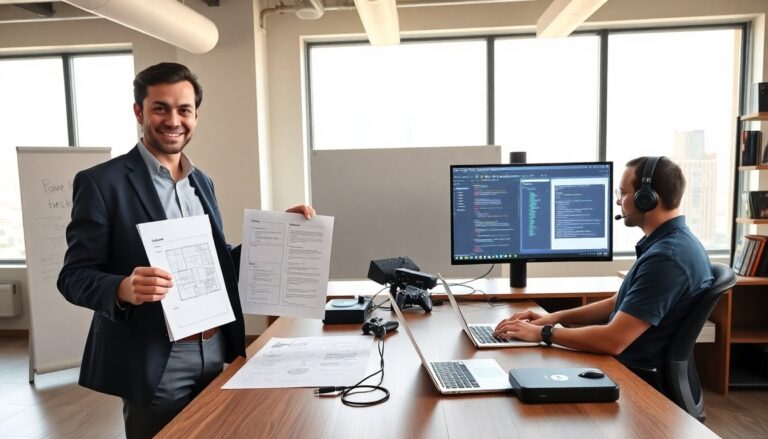


Game design vs game development splits creative planning from technical building. This article clarifies each path. It lists roles, core tasks, and key skills. It helps readers decide which path fits their strengths and goals.
Key Takeaways
- Game design focuses on creating game rules, systems, and player experiences, requiring creativity and clear communication.
- Game development involves writing code, building assets, and technical implementation to bring designs to life.
- Designers and developers collaborate closely through clear handoffs, communication tools, and iterative testing to ensure project success.
- Career paths for designers and developers can diverge or overlap, with skills like scripting or UX enhancing cross-role capabilities.
- Understanding the distinct roles and workflows helps individuals align their strengths with either game design or game development.
- Strong portfolios, effective teamwork, and continuous learning are crucial for success in both game design and game development careers.
What Is Game Design? Roles, Core Responsibilities, And Key Skills
Game design vs game development starts with design. A game designer defines rules, systems, and player goals. They write documents, sketch levels, and test ideas. They create core loops, progression, and reward paths. They tune numbers and craft player feedback.
Design roles vary by studio size. A lead designer sets vision and guides teams. A systems designer builds mechanics and balance. A level designer shapes maps and encounters. A narrative designer writes story, dialogue, and character motivation. A UX designer designs menus and control flow.
Designers use specific skills. They think about player flow and pacing. They write clear design documents. They prototype in simple tools or engines. They run playtests and collect feedback. They analyze metrics and change design based on data.
Designers need soft skills too. They communicate ideas to artists, programmers, and producers. They accept feedback and revise work. They prioritize features and manage time. They present design choices to stakeholders.
Game design vs game development shows different daily tasks. Designers sketch and test ideas. They iterate on rules and content. They focus on player experience more than code. They use tools like paper, spreadsheets, and engine editors. They need a mix of creative thought and practical execution.
What Is Game Development? Technical Roles, Workflow, And Toolchains
Game design vs game development splits responsibilities. Game developers write code, build assets, and integrate systems. They make the game run on target hardware. They fix bugs and optimize performance. They carry out design choices into working features.
Development roles vary by discipline. A gameplay programmer implements mechanics and player input. An engine programmer builds rendering, physics, and core systems. A tools programmer creates editors and pipelines. An audio programmer links sound systems. A technical artist bridges art and code.
Developers follow a workflow. They pull tasks from a tracker. They write code, test locally, and push changes. They run automated tests and build nightly versions. They profile performance and optimize bottlenecks. They merge art and code in a continuous integration process.
Developers use specific toolchains. They code in C++, C#, or scripting languages. They use engines like Unity or Unreal Engine. They use version control like Git or Perforce. They use build servers for multi-platform targets. They use profilers and debuggers for performance.
Developers need technical skills and habits. They write clean, testable code. They document interfaces and APIs. They read design docs and ask clarifying questions. They estimate effort and communicate blockers. They collaborate with designers to match intent with implementation.
How Designers And Developers Collaborate: Handoffs, Communication, And Career Paths
Designers and developers work together on the same product. Designers deliver design docs, diagrams, and prototypes. Developers convert those items into code and scenes. Both sides attend planning meetings and sprint reviews.
Teams use clear handoffs. Designers mark feature scope, success criteria, and edge cases. Developers review scope and estimate time. Designers provide example content and reference assets. Developers provide tech limits and integration notes.
Teams use simple communication patterns. They keep trackers updated. They write short tickets with acceptance criteria. They use daily standups to surface blockers. They use design reviews to catch issues early. They run playtests to validate combined work.
Collaboration tools keep work aligned. Teams use issue trackers, design docs, and shared prototypes. Teams use version control for assets and code. Teams use continuous builds to test cross-discipline changes.
Career paths diverge and cross. A designer can move to lead design or creative director. A programmer can move to lead engineer or technical director. A person can switch roles by building relevant skills. A designer who learns scripting can prototype faster. A developer who studies UX can shape better interfaces.
Game design vs game development demands different training. Schools teach core theory for designers and computer science for developers. Self-taught professionals build portfolios with prototypes and mods. Studios value clear communication, craft, and the ability to ship. They hire people who show strong, real work and who work well with teams.